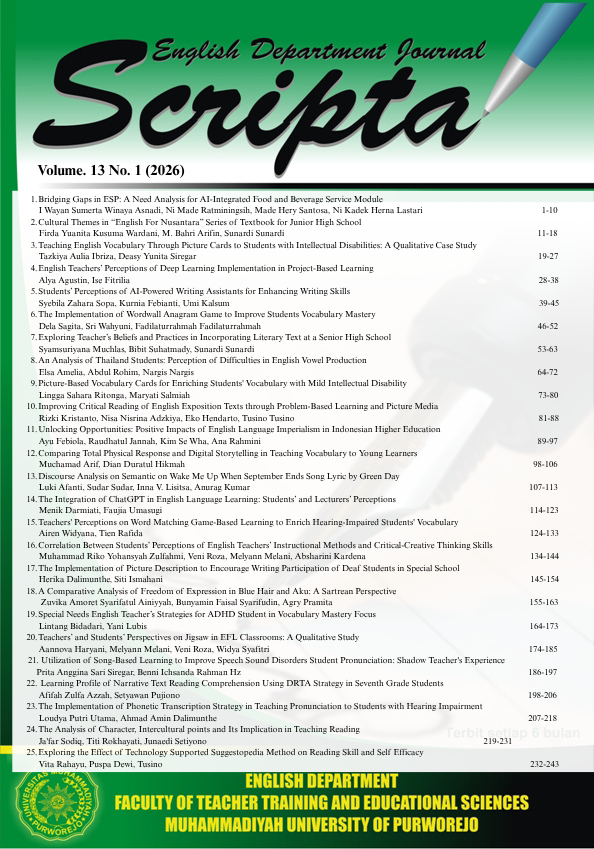
Comparing Total Physical Response and Digital Storytelling in Teaching Vocabulary to Young Learners
Abstract
Vocabulary development is a fundamental component of English language learning in early childhood because it provides the basis for communication and comprehension. However, despite the importance of vocabulary, research in the Indonesian PAUD context still pays limited attention to how different instructional methods compare in effectiveness. This study seeks to fill this gap by investigating the use of Total Physical Response (TPR) and Digital Storytelling (DST) as strategies for teaching English vocabulary to young learners. Employing a quasi-experimental design, 40 children aged 5–6 from two PAUD institutions in Surabaya were purposively sampled and divided into two groups: one taught with TPR and the other with DST. Data were collected through pre-tests, post-tests, classroom observations, and teacher interviews. Quantitative data were analyzed using paired t-tests and ANOVA, while qualitative data were thematically analyzed to capture engagement and learning experiences. The findings indicate that both TPR and DST significantly improved vocabulary mastery, but with distinct advantages: TPR enhanced immediate recall and kinesthetic engagement, whereas DST promoted contextual understanding and long-term retention. Teacher reflections further revealed that TPR stimulated motivation yet posed classroom management challenges, while DST enriched learning but required greater preparation and technological access. These results suggest that integrating TPR and DST offers a balanced and effective approach to vocabulary instruction in PAUD classrooms, providing valuable pedagogical implications for teachers and policymakers in early childhood English education.
Downloads
Copyright (c) 2026 Scripta : English Department Journal

This work is licensed under a Creative Commons Attribution-ShareAlike 4.0 International License.